Outdoor furniture has traditionally been associated with physical retail.
Customers wanted to sit on a chair, inspect a table, compare finishes and judge the quality of materials before committing to a purchase. For larger outdoor products, seeing the physical scale of an item could also make the difference between confidence and hesitation.
E-commerce has changed that buying journey.
Customers can now discover outdoor furniture through search engines, social media, digital advertising, product marketplaces and brand websites before they ever visit a showroom. They can compare styles, dimensions, materials, colours and prices, read customer reviews and view photographs of products in completed outdoor spaces.
This does not mean physical retail has become irrelevant. Outdoor furniture remains a category where customers can value physical inspection, particularly for larger or higher-priced purchases.
Instead, e-commerce has become another important part of how customers research, compare and purchase outdoor lifestyle products.
The Australian retail market provides evidence of continuing activity in household and furnishing categories. In December 2025, Australian household spending volumes for furnishings and household equipment increased 3.6% compared with the previous quarter. Earlier in 2025, the ABS also recorded monthly increases in furniture, floor coverings, houseware and textile retailing in both April and June. These figures cover broader categories than outdoor furniture specifically, so they should not be interpreted as direct measurements of outdoor furniture e-commerce. They do, however, illustrate the continuing importance of the wider household goods market.
For outdoor furniture and lifestyle businesses, the opportunity is therefore not simply to put products online.
It is to create an e-commerce experience that helps customers understand the product, imagine it in their own outdoor space and feel confident enough to buy.
Customers Are Already Researching Outdoor Spaces Online
The buying journey for outdoor furniture often begins before a customer has decided exactly what they want.
Someone may start by looking for:
- Outdoor entertaining ideas
- Patio furniture inspiration
- Outdoor dining ideas
- Small balcony furniture
- Poolside seating
- Modular outdoor lounges
- Weather-resistant outdoor furniture
- Outdoor lighting
- Garden furniture
- Outdoor kitchen accessories
At this stage, the customer may not be ready to purchase.
They are developing an idea.
This is important because an e-commerce website can participate in that early research rather than waiting until the customer searches for an exact product name.
Useful content, project photography, buying guides and category pages can introduce customers to products while they are still planning their outdoor space.
The customer may eventually move from:
Inspiration → Research → Comparison → Product evaluation → Purchase
A strong e-commerce strategy supports each stage.
Outdoor Furniture Is Naturally Suited to Visual Commerce
Outdoor furniture is highly visual.
Customers often make decisions based partly on how a product looks within a broader environment.
A product photograph can show the construction of a chair.
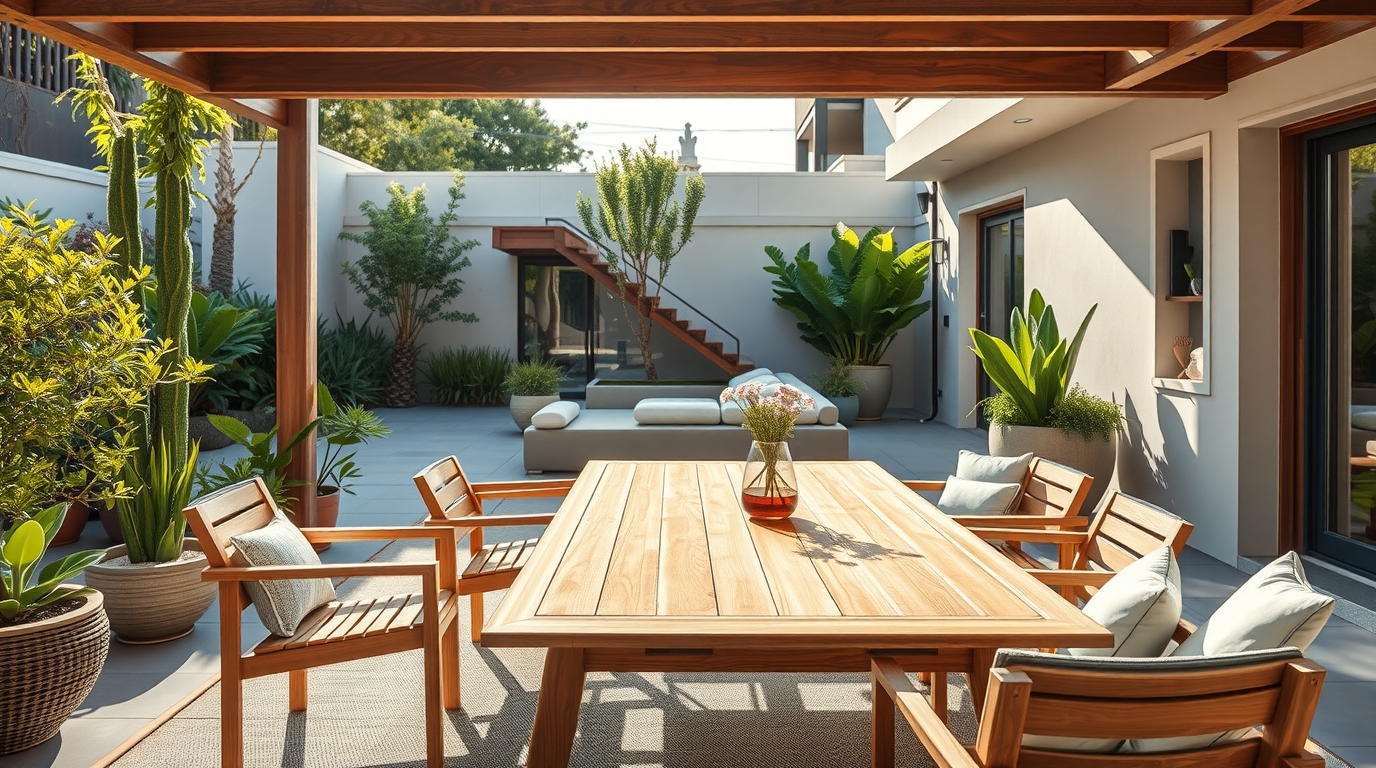
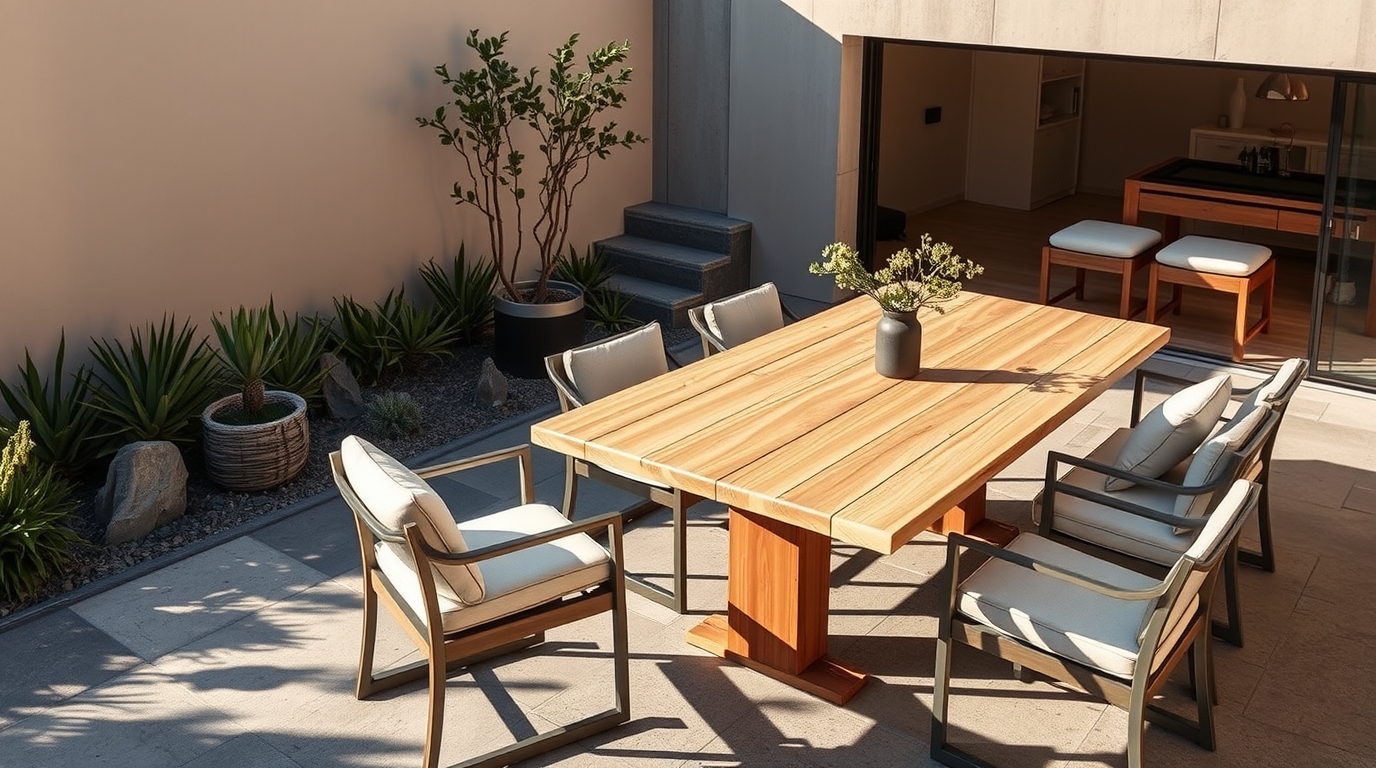
A styled outdoor photograph can show what the chair contributes to a complete space.
That difference matters.
Consider a modular outdoor lounge.
A standard product image might show the sofa against a plain background.
A stronger e-commerce presentation could also show the same product:
- On a covered patio
- Around an outdoor coffee table
- Beside an outdoor rug
- With cushions and accessories
- In a compact entertaining area
- In a larger landscaped setting
This gives customers context.
They can start imagining how the product might work in their own property.
For outdoor lifestyle brands, e-commerce therefore overlaps naturally with visual merchandising.
Customers Can Compare Products More Easily Online
Physical retail has traditionally given customers the opportunity to compare products in person.
E-commerce provides a different form of comparison.
A customer can open several product pages and compare:
- Dimensions
- Materials
- Colours
- Finishes
- Features
- Prices
- Availability
- Delivery information
- Reviews
- Warranty information
This is particularly useful when customers are researching larger purchases.
A website should make that comparison process straightforward.
Product specifications should be presented consistently.
If one dining table lists dimensions as width × depth × height while another uses a different format, comparison becomes unnecessarily difficult.
Similarly, material information should be specific.
“Premium quality” tells a customer very little.
“Powder-coated aluminium frame with outdoor-rated finish” provides considerably more useful information when that description is accurate.
The more information customers need to compare, the more important product-page structure becomes.
Product Pages Are Becoming Digital Showrooms
For an outdoor furniture business, the product page increasingly performs some of the functions that a showroom salesperson traditionally performed.
It needs to answer questions.
How large is the product?
What is it made from?
Is it suitable for outdoor use?
How should it be maintained?
What colours are available?
Does it require assembly?
How much does it weigh?
What is included?
When can it be delivered?
What happens if there is a problem?
A strong product page anticipates these questions.
It also presents the product visually.
This combination of information and imagery is particularly important for outdoor furniture because customers cannot physically inspect the item through the screen.
The website therefore needs to compensate by providing better information.
E-Commerce Makes More Product Variations Practical
Outdoor furniture frequently comes in multiple configurations.
A dining chair may be available in several colours.
A modular lounge may have different configurations.
A dining table may be available in multiple sizes.
A cushion may have several fabrics.
An outdoor umbrella may have different dimensions and finishes.
E-commerce platforms can present these variations within a structured shopping experience.
Google’s current product documentation specifically recognises furniture as a category commonly sold with different variations such as size, colour, material and pattern. Google provides ProductGroup and Product structured data to help search engines understand relationships between variants.
For retailers, this creates another reason to structure product data carefully.
The website needs to make it clear which variation the customer has selected and update relevant information such as price, availability and imagery where appropriate.
The experience should be equally clear to the customer and to search engines.
Customers Can Shop Around Their Own Schedule
One of the fundamental advantages of e-commerce is convenience.
A customer does not need to visit a showroom during opening hours to begin researching outdoor furniture.
They can browse in the evening.
They can compare products over a weekend.
They can revisit a product page several days later.
They can share a product with a partner.
They can return to a saved shopping cart.
This is particularly relevant to outdoor lifestyle purchases because these decisions are often connected to broader household projects.
A customer may be planning landscaping, renovating a patio or preparing an entertaining area.
The furniture purchase is one part of a larger project.
Online shopping allows customers to research products alongside those other decisions.
E-Commerce Expands the Reach of Outdoor Furniture Brands
A physical showroom has a geographical limit.
A website can potentially introduce products to customers beyond the immediate local area, subject to delivery capability and commercial viability.
This creates opportunities for businesses with distinctive products.
A specialist outdoor furniture brand may have a relatively narrow physical presence but a much broader online audience.
The website can make products discoverable through:
- Organic search
- Google Shopping
- Paid search
- Social media
- Email marketing
- Direct traffic
- Product marketplaces where appropriate
However, broader reach does not automatically mean broader profitability.
Delivery costs, freight damage, returns, customer support and geographic service limitations can make some areas commercially unattractive.
An e-commerce strategy should therefore define where the business can realistically sell profitably.
Product Discovery Is Increasingly Connected to Search
Search engines remain important because customers frequently use them when they have a particular product or problem in mind.
Someone might search:
outdoor dining table
or:
extendable outdoor dining table
or:
aluminium outdoor dining table
or:
outdoor lounge for small patio
These searches reveal progressively different levels of specificity.
An e-commerce website can build category and product pages around genuine customer needs.
A broad category page can introduce the range.
A more specific category can address a narrower product type.
An individual product page can provide the detailed information required for purchase.
This creates a useful information architecture.
It also allows SEO to support different stages of the customer’s research process.
Google Shopping Can Put Products Directly in Front of Buyers
E-commerce businesses have another advantage over purely service-based businesses.
Products can be presented directly within search and shopping experiences.
Google’s current merchant listing documentation explains that eligible product structured data can support merchant listing experiences that display information such as product price, availability, shipping and return information.
This means technical product information is not merely an internal e-commerce concern.
Accurate product data can contribute to how products are understood and represented across search experiences.
For outdoor furniture businesses, this makes accurate information about:
- Product names
- Prices
- Availability
- Images
- Variants
- Product identifiers
- Shipping
- Returns
particularly important.
High-Quality Product Photography Becomes More Important Online
When customers cannot physically touch a product, photography carries more responsibility.
Outdoor furniture photography should show the product clearly and honestly.
Useful images may include:
- Full product view
- Multiple angles
- Close-up of materials
- Frame details
- Surface finishes
- Cushion fabrics
- Hardware
- Scale within an outdoor setting
- Different configurations
- Product in use
Lifestyle photography is particularly valuable.
A customer may understand the dimensions from a specification table, but an image showing the product beside people, a table or a building can help communicate scale.
Photography can also communicate brand positioning.
A premium outdoor furniture company should ensure its imagery reflects the quality and design character of the products.
Customers Want to Understand Materials and Durability
Outdoor furniture faces conditions that indoor furniture does not.
Customers may be concerned about:
- Sun exposure
- Rain
- Moisture
- Temperature changes
- Dirt
- Coastal environments
- Maintenance
- Fabric performance
- Corrosion
- Fading
The appropriate considerations depend on the product and materials.
This creates an opportunity for e-commerce businesses to provide useful product education.
Instead of simply stating that a product is “built for outdoors”, explain the relevant materials, finishes and care requirements accurately.
For example, if a particular frame material has specific maintenance requirements, provide them.
If cushions should be stored under certain conditions, explain that.
If a finish is suitable for particular environments but requires maintenance, be transparent.
This information can reduce uncertainty and support better purchasing decisions.
Outdoor Furniture E-Commerce Needs Stronger Delivery Information
Furniture creates a practical challenge that smaller online products may not face.
Large items can be expensive and complicated to deliver.
Customers may need to know:
- Delivery regions
- Freight charges
- Delivery timeframes
- Whether delivery is to the kerb or inside the property
- Whether assembly is included
- Whether multiple people are required to receive the item
- Whether access restrictions apply
- What happens if the product arrives damaged
This information should not be hidden until checkout.
Delivery is part of the purchase decision.
A product that appears attractively priced may become much less appealing when freight is added at the final stage.
Clear information creates a more trustworthy experience.
Returns and Warranty Information Can Reduce Purchase Anxiety
A customer buying a cushion online faces relatively little risk compared with someone ordering a large outdoor dining setting.
The higher the purchase value and physical complexity, the more important reassurance becomes.
The website should clearly explain applicable:
- Returns policy
- Warranty
- Damaged goods process
- Fault reporting
- Change-of-mind conditions
- Delivery issues
- Product care responsibilities
The exact policies will depend on the business and applicable consumer law.
The important point is accessibility.
Customers should not have to search through multiple pages to discover what happens if something goes wrong.
Clear policies can remove uncertainty before the purchase rather than attempting to resolve it afterwards.
Reviews Provide Social Proof
Reviews can be particularly useful for outdoor furniture because customers cannot physically inspect the product before buying online.
They want to know what other customers experienced.
Useful reviews can address:
- Product quality
- Appearance
- Comfort
- Assembly
- Delivery
- Packaging
- Communication
- Customer service
- Long-term use
Where customers have supplied photographs, genuine user-generated imagery can provide additional context.
A photograph of an outdoor lounge in a real backyard can sometimes answer questions that a professional product photograph cannot.
Businesses should, however, ensure reviews are genuine and represented accurately.
Trust is difficult to build and easy to damage.
E-Commerce Allows Outdoor Brands to Sell the Complete Lifestyle
One of the strongest opportunities in outdoor lifestyle e-commerce is that customers rarely think about one product in complete isolation.
They may be planning an outdoor room.
That could include:
- Lounge seating
- Dining furniture
- Coffee tables
- Umbrellas
- Outdoor rugs
- Lighting
- Heating
- Planters
- Accessories
- Storage
- Decorative pieces
This creates opportunities for merchandising around complete solutions.
Instead of only showing:
Outdoor Dining Table
the website might also help customers discover:
Complete Outdoor Dining Collection
or:
Products for Entertaining Outdoors
This can encourage customers to think beyond individual products.
It also provides opportunities for complementary sales.
The objective should not be to force additional products into every purchase.
It is to make it easier for customers to build a coherent outdoor environment.
Content Can Help Customers Make Better Decisions
E-commerce and content marketing should not operate separately.
Customers have practical questions before buying outdoor furniture.
A business can answer them through useful content such as:
- How to Choose Outdoor Furniture for a Small Patio
- What to Look for in an Outdoor Dining Table
- How to Maintain Outdoor Furniture
- Outdoor Furniture Materials Compared
- How to Create a Comfortable Outdoor Entertaining Area
- How to Choose Outdoor Seating
- Outdoor Furniture Ideas for Pool Areas
- How to Arrange Furniture on a Covered Patio
These resources can attract search traffic while also supporting customers who are already browsing products.
The best content connects naturally to the products.
For example, an article comparing outdoor furniture materials can link to relevant aluminium, timber or composite product collections where those products are actually available.
This creates a pathway from education to shopping.
Social Media Can Become a Product Discovery Channel
Outdoor furniture is particularly suitable for visual social media.
A finished outdoor space can provide inspiration long before the customer knows which products they want.
Businesses can use social content to show:
- Complete outdoor settings
- Product details
- Styling ideas
- Customer spaces
- Seasonal arrangements
- New collections
- Material close-ups
- Before-and-after spaces
- Product demonstrations
- Maintenance tips
The content should not simply reproduce catalogue photography.
The strongest social content can show how products are used.
This helps bridge the gap between inspiration and e-commerce.
A customer may discover a complete outdoor setting through social media, visit the website to identify the individual products and then continue researching before purchasing.
Personalisation and Configuration Can Improve the Shopping Experience
Outdoor furniture increasingly includes configurable elements.
Customers may be able to select:
- Size
- Fabric
- Frame finish
- Configuration
- Cushion colour
- Module arrangement
A strong e-commerce experience should make these choices easy to understand.
Visual swatches can be more useful than text-only dropdown menus.
If a colour selection changes the product photograph, the customer should see the result where the technology allows.
If selecting a larger configuration changes the price, that should be clear.
Google’s product variant guidance specifically covers furniture sold in variations such as size, colour and material, reinforcing the importance of accurately representing these relationships online.
The goal is to make customisation feel manageable rather than complicated.
E-Commerce Can Support Physical Showrooms Rather Than Replace Them
The idea that online and physical retail must compete with each other is increasingly limiting.
An outdoor furniture business with a showroom can use its website to support showroom visits.
Customers can:
- Research products online
- Check specifications
- Compare collections
- Save products
- Identify preferred colours
- Locate the showroom
- Arrange a visit
- Contact the team
The showroom can then provide the physical experience.
A customer may sit on a lounge, inspect a finish or compare fabrics before completing the purchase online.
Conversely, someone who visits a showroom may later return to the website to finalise an order.
This is an omnichannel customer journey rather than a simple online-versus-offline choice.
E-Commerce Can Create a More Measurable Sales Process
Physical retail can provide valuable customer interactions, but online shopping creates extensive behavioural data.
Businesses can analyse:
- Product views
- Category views
- Search behaviour
- Product comparisons
- Add-to-cart activity
- Checkout starts
- Purchases
- Abandoned carts
- Average order value
- Revenue by product
- Revenue by channel
- Conversion rate by device
This can help identify where customers encounter friction.
For example, if a product receives significant traffic but few customers add it to their carts, the business might investigate:
- Price
- Product presentation
- Photography
- Information
- Availability
- Delivery costs
- Customer reviews
- Product-market fit
Analytics cannot automatically explain why customers behave in a particular way, but it can identify areas that deserve investigation.
Abandoned Carts Can Reveal Friction
Outdoor furniture purchases may involve significant consideration.
A customer can add a product to their cart and then pause.
That does not necessarily mean the sale is lost permanently.
They may be comparing prices.
They may need to discuss the purchase with another household member.
They may have discovered an unexpected delivery cost.
They may simply be waiting until payday.
E-commerce businesses can use appropriate, privacy-compliant email or remarketing strategies to bring customers back to products they previously considered.
However, the more important task is understanding why abandonment occurs.
If many customers abandon at the shipping stage, the problem may not be the customers.
It may be the way delivery costs are communicated.
If customers repeatedly abandon after viewing a particular product, the business may need to investigate its price, information or availability.
Mobile Shopping Cannot Be an Afterthought
Customers increasingly research products from mobile devices.
An outdoor furniture website therefore needs to provide a good mobile experience.
This includes:
- Fast-loading images
- Readable product descriptions
- Easy navigation
- Simple product filtering
- Clear variant selection
- Visible pricing
- Easy cart access
- Straightforward checkout
- Mobile-friendly payment options
Outdoor furniture pages can contain a large amount of information.
The challenge is presenting that information without making the page feel overwhelming.
Important details should be easy to find while additional specifications can be organised logically.
SEO and E-Commerce Should Be Built Together
SEO should not be added to an e-commerce website after the catalogue has already been built.
The architecture of the store affects search visibility.
A well-structured site might have:
Outdoor Furniture
→ Outdoor Dining
→ Outdoor Lounges
→ Outdoor Chairs
→ Outdoor Tables
→ Outdoor Accessories
→ Individual Products
This creates logical relationships between broad categories, specific collections and individual products.
Product pages should contain useful information rather than short descriptions copied from manufacturers.
Where products are variants of the same underlying product, the technical implementation should also communicate those relationships appropriately.
Google’s documentation states that Product structured data can make eligible product pages available for merchant listing experiences, including information such as price, availability, shipping and return details.
Technical SEO therefore forms part of the commercial e-commerce infrastructure.
Build Product Pages Around Customer Questions
A useful test for an outdoor furniture product page is to imagine a customer standing in a showroom asking questions.
Would the page answer:
What is it made from?
How large is it?
Is it comfortable?
What does the finish look like?
Is it suitable for my environment?
How do I maintain it?
What colours are available?
How much does delivery cost?
When will it arrive?
What happens if there is a problem?
If the website cannot answer these questions, customers may leave to find the information elsewhere.
Once customers leave, they may encounter a competitor.
Good e-commerce content therefore serves a defensive function as well as an SEO function.
It keeps customers informed within the brand’s own digital environment.
Use Email to Build Repeat Relationships
Outdoor lifestyle purchases can create opportunities for future sales.
A customer who buys an outdoor dining setting may later need:
- Cushions
- Covers
- Accessories
- Lighting
- Side tables
- Replacement components
- Additional seating
Email marketing can keep the relationship active when customers have given appropriate consent.
Useful email content could include:
- Product care advice
- Seasonal outdoor styling
- New collections
- Relevant accessories
- Maintenance reminders
- Inspiration
- Product guides
The objective should not be constant promotion.
Useful communication can keep the brand relevant between purchases.
E-Commerce Growth Does Not Mean Every Product Should Be Sold Online
An important distinction needs to be made.
E-commerce is highly suitable for some outdoor lifestyle products.
Smaller accessories, cushions, lighting, décor and standardised furniture can often be purchased with relatively little assistance.
Large custom outdoor structures are different.
A customer buying a custom outdoor kitchen, pergola or complete outdoor living installation may need a consultation, site assessment and quotation.
In those cases, the website may be better designed to generate a qualified lead rather than complete an immediate transaction.
This means an outdoor lifestyle business may operate a hybrid model:
E-commerce for products
and
lead generation for custom services.
Both can exist on the same website.
Think About the Commercial Economics
E-commerce creates access to a larger potential customer base, but online sales also introduce costs.
Businesses need to account for:
- Website development
- Platform fees
- Payment processing
- Product photography
- Digital advertising
- Packaging
- Warehousing
- Freight
- Returns
- Customer support
- Damaged deliveries
- Inventory management
A product can generate substantial online revenue while producing limited profit if the underlying economics are weak.
Outdoor furniture is particularly sensitive to freight and handling costs because products can be large and heavy.
This makes gross margin and fulfilment economics just as important as conversion rate.
A strong e-commerce strategy therefore asks:
Which products can we sell online profitably, to which customers, through which channels?
That is a more useful question than simply asking how to increase website sales.
Measure E-Commerce Performance Beyond Revenue
Revenue is important, but it should not be the only metric.
Useful measures include:
- Conversion rate
- Average order value
- Gross margin
- Revenue by product
- Revenue by category
- Cost per acquisition
- Return rate
- Cart abandonment
- Customer acquisition cost
- Repeat purchase rate
- Revenue by marketing channel
- Profitability by product
For example, a product with a high conversion rate may appear successful.
But if it has a low margin and high freight costs, another product with fewer sales may be commercially more valuable.
Similarly, a paid advertising campaign that generates substantial revenue may still be unattractive if acquisition costs consume too much margin.
E-commerce reporting should therefore connect marketing performance with actual business economics.
Common Mistakes Outdoor Furniture Businesses Should Avoid
Treating the website as an online catalogue
A product list without useful information does not provide the buying experience customers need.
Using weak photography
Poor imagery can make good products difficult to evaluate.
Hiding delivery costs
Unexpected freight charges can create friction at checkout.
Providing vague product descriptions
Customers need specific information about dimensions, materials, care and use.
Ignoring product variants
Different sizes, colours and configurations should be easy to understand.
Making mobile shopping difficult
Customers should not have to fight the website to complete a purchase.
Relying entirely on discounts
Price promotions can attract attention, but they do not create a sustainable brand strategy on their own.
Ignoring SEO
A beautiful store that cannot be discovered through relevant searches is dependent on other marketing channels.
Treating every product as a direct e-commerce purchase
Some high-value or customised outdoor products are better suited to consultation-led sales.
Measuring only sales
Revenue without margin, acquisition cost and fulfilment economics provides an incomplete picture.
A Practical Framework for Building an Outdoor E-Commerce Strategy
Outdoor furniture and lifestyle businesses can approach e-commerce development in a structured way.
1. Review the product range
Identify which products are straightforward to purchase online and which require consultation.
2. Improve product information
Add detailed specifications, materials, dimensions, care information, availability and delivery details.
3. Upgrade photography
Combine product photography with lifestyle imagery showing products in realistic outdoor environments.
4. Build logical categories
Organise products around how customers actually shop.
5. Make variations easy to understand
Use visual selectors and clear pricing where products have multiple options.
6. Strengthen trust
Add genuine reviews, warranty information, policies and evidence of the business behind the products.
7. Improve search visibility
Develop category pages, product pages and useful content around real customer searches.
8. Connect products with inspiration
Show customers how individual pieces can contribute to complete outdoor spaces.
9. Make delivery transparent
Explain shipping costs, delivery timeframes and handling requirements before checkout.
10. Measure commercial performance
Track conversion, average order value, acquisition cost, margin, returns and repeat purchases.
11. Connect e-commerce with other marketing
Use SEO, Google Ads, social media, email and content to bring qualified customers into the store.
12. Improve continuously
Use customer behaviour, sales data and customer feedback to identify where the experience can be strengthened.
The Future of Outdoor Furniture Retail Is Not Simply Online
The growth of e-commerce does not mean customers will stop valuing physical showrooms or tactile experiences.
Outdoor furniture is too closely connected to comfort, scale, materials and visual context for physical interaction to become irrelevant.
Instead, the customer journey is becoming more connected.
A customer may discover an outdoor lounge through social media, research the product through Google, compare specifications on an e-commerce website, visit a showroom to experience it physically and then return online to complete the purchase.
Another customer may complete the entire journey online.
Another may use the website to research a custom project before contacting the business for a consultation.
The successful outdoor furniture and lifestyle businesses will therefore not necessarily be those that simply “move online”.
They will be the businesses that understand what customers need at each stage of the journey and build digital experiences around those needs.
E-commerce provides convenience, product discovery, comparison, detailed information and a direct route to purchase. For businesses, it can expand reach, create measurable sales activity and connect products with customers beyond the limitations of a physical store.
But the fundamentals remain the same.
Products need to be good.
Information needs to be accurate.
Photography needs to be convincing.
Delivery needs to be practical.
Pricing needs to make commercial sense.
Customer service needs to support the purchase.
And the website needs to make the customer’s decision easier.
For outdoor furniture and lifestyle businesses, that is the real opportunity in e-commerce. It is not simply about putting more products online. It is about creating a digital shopping experience that helps customers discover, understand, compare and confidently purchase products that will become part of how they use their outdoor spaces.
If your business operates in the home and lifestyle sector and you would like to improve the commercial performance of your e-commerce website, Home & Lifestyle Marketing Co can help assess how website development, SEO, Google Ads, social media and conversion strategy can work together to support sustainable online growth.
To learn more, please visit www.hlmco.com.au